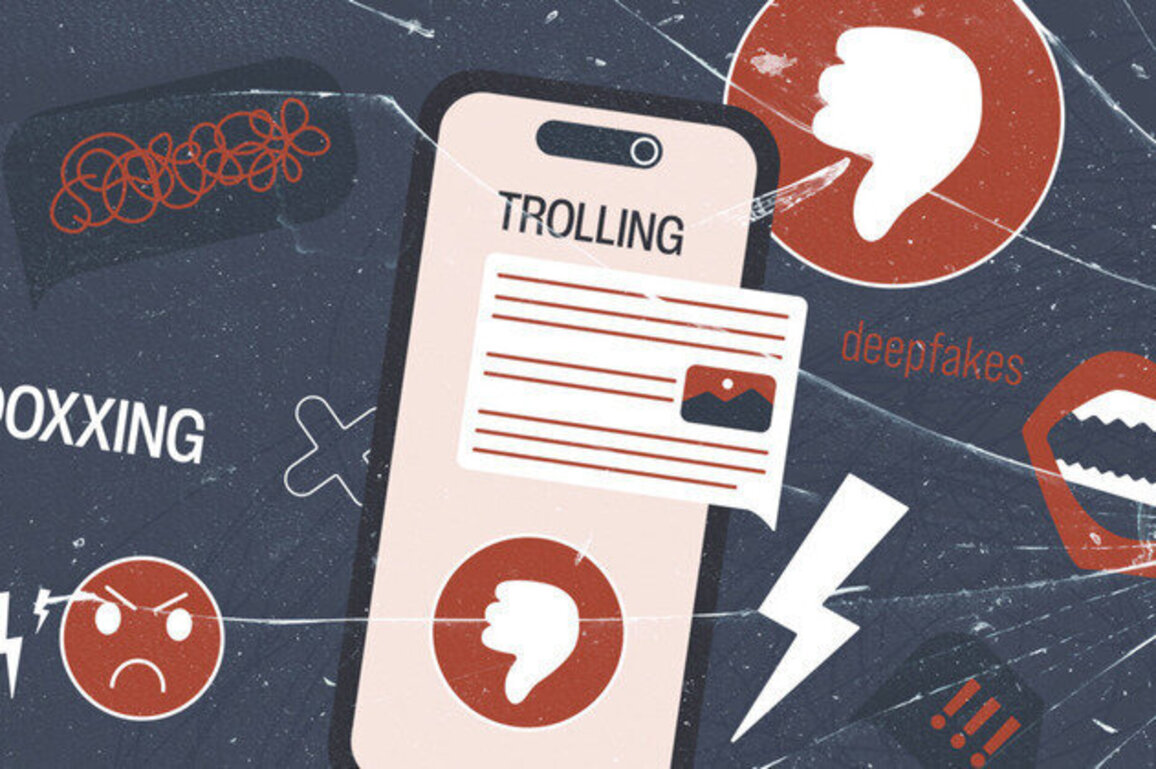
Deepfakes, trolling, doxing and more: New termshave been coined to describe online violenceand how victims are targeted in the virtual world muchof the abuse directed againstwomen.According to theUN,digital attacks have becomeone of the main vectors of gender-based violence worldwide.
A 2021 studyconducted by theEconomist Intelligence Unitin 45 countries revealed that 85percentof women have been victims of,or witnesses to,online violenceor violencefacilitatedby technologyincluding74percentof womeninEurope, 91percentinLatin Americaand the Caribbean and 90percent inAfrica.Cyberviolencealsoaffects nine out of10women who arealreadyvictims of domestic violence, according to a study by theHubertineAuclertCentre, a French groupthat works to promote gender equality and combat violence against women.
This explosion of cyberviolence goes hand in handwith advancesindigital technologies.With thespreadof generative AI, attacksare now moreextreme, morecoordinatedand moresexualised including aproliferation of deepfakesused toviolate women's privacy.
Read moreCyberbullying led to a 'deterioration' in Brigitte Macron's health, daughter says
But thedramatic increasein online abusecannot be explained solely bynewtechnologies. It alsofollowsarise of masculinist a counterpart tofeminism, advocating male interests narrativesthathave redefineddigitalcultureandled to uninhibited aggression towards women.
Forums for incels (involuntary celibates), videos by misogynistic influencers and anti-feminist or anti-woke communities pervade online platforms. According toa report bythe Frenchthink tank Iris,it takesless than 30minutes for algorithms to recommend such content to young male internetusers.
As a result,masculinist discourse is reaching a wider audience and spawning digital aggression that is also politicised andincreasinglysocially accepted. This further fuels thetypes ofdigitalabuse thathavelong targeted women and gender minorities.
From sexism to astructured ideology
Cyberviolence is not a private issue but an integral part of the continuum of violence against women and girls,theEuropean Institute for Gender Equality (EIGE)saidina 2022 reportdocumenting the extent of gender-based digital violence.
The type of violencethat already exists offline is amplifiedin the digital space.
Masculinist propaganda then gives fresh meaning and direction to this entrenched violence, transforming it into a structured mobilisation against women.
The tens of thousands of men who have shared real or fake pornographic images of women sometimes members of their own families onFacebookgroups, WhatsApp or Telegramare taking part in systemic violence against women, says AliceApostoly, co-director of theGender in GeopoliticsInstituteinParis.
Apostolysaysthe explosion of masculinistdiscoursespreadsmisleading information based onmisogynistand sexist stereotypes,which gives weightto sexist and sexual violence targeting feminist activists, femalepoliticians, journalists and artists.
It is precisely this ideological dimension the transformation ofimpulsivemale anger into a political narrative that distinguishestraditionaldigital violence from itsmore recentmanifestation: the mobilisation of radicalised groups of menseekingto punish, intimidate or silence womenwho are inthe public sphere.
This phenomenon, widespread on digital platforms, goes far beyond theideaof loneincels spouting vitriol from behind the safety of their screens.
Whilemedia coverage of theonceobscuremasculinist movement has focused in recent yearsonincels highlighted in theNetflixseriesAdolescenceand implicated in terrorist attacksthat haveleft dozens deadsince 2014 it often overlooksmanyother openly misogynistic groups.
Read moreShould Frances incel threat be treated like terrorism?
These groups share the samefixations: hatred of feminism, nostalgia for a patriarchal order and thebeliefthat men are now victims.
Theirhuge online presence playsa central rolein spreading and normalising digital violence.
Organised violence
Theattention given toBritish influencer Andrew Tate, a leading light in the masculinist movement, obscures the collective dimension of masculinism, which Stphanie Lamy, researcher and author ofLaTerreurmasculiniste(Masculinist Terror), prefers to treat in the plural.
Masculinismsare an ideological offering developed in radical circles, characterised by a diversity of ideologies, the collectivisation of resources and the glorification of violence in all its forms,shesays. What differentiates masculinist discourse from misogyny andsexismis therefore thiscollective and organised dimension.
Theonly knownkilling inFrance motivated by a masculinist ideology, themurderof Mlanie Ghione by MickalPhiltasin 2020 wasnot legally classified as anideologicalattack.
But Lamy notes that there was indeed collaboration with other members of the same anti-feminist circle that Philtas claimed hebelonged to,the MGTOW group, forMen Going Their Own Way. Soit was indeed organised,shesays.
InSaint-Etienne,Bordeauxand Annecy, three men were arrested between 2021 and 2023 while planning attacks against women and gathering weapons for thispurpose.
In the case of Timothy G., suspected of planning to attack women in Saint-tienne, witnesses said he had been encouraged totake actionwithin theincelforums he frequented.There are no lone wolves,Lamy says.
Propaganda, whatever form it takes, shapesperceptionsand reflexes. When we see hateful comments under a feminist post, it may have been posted in a forum with a call to carry outan attack,notes Lamy,ora targeted harassment campaign against women.But it may also be that some men act on their own initiative, because they have already been conditioned to react in this way.
Normalisation of misogyny, a major blind spot in legislation
Masculinism provides a common language, with its own justifications and targets. And the more this framework becomes normalised, the more digital violence proliferates.
If cyberviolence against women and gender minorities otherwise known astechnology facilitated gender-based violence" (TFGBV) has exploded in recent years, it is indeedbecause digital technology is becoming increasingly politicised,saysLamy. "The more visible women are in the public sphere, the more they become targets."
And if they are increasingly targeted, it is because there are increasingly motivated groups of men who are organising themselves to attack them.
Lamysayssuchmisogynisticattacksofferritualsthat allowindividualsto unite, take joint actionto feelpart of a group andrally.
Read moreFour men convicted of cyberbullying French DJ Olympics performer
ForApostoly, these are acts of political violence, which havea very clear objective: to make women invisible and silence them in the digital public sphere and in the public sphere in general.
The normalisation of this type of violence is all the more problematic as it thrives in the absence of almost any legal sanctions.
In its 2022 report, theGroup of Experts on Action against Violence against Women and Domestic Violence(Grevio)noted:While many countries have adopted new laws to criminalise certain forms of technology-facilitated online abuse, many provisions are limited in scope, as is their practical implementation.
The moderation of hate speech is linked to a complex web of European and national legislation and regulations that stem from the fight againstterrorism,explains Lamy."The first European standards were driven by this, focusing on racial hatred and completely overlooking misogyny.It'sa huge blind spot.
Yet the same mechanisms ofradicalisation, expression of hatred andhierarchisation ofhumansare at work, shesays.
As a result, various online community platforms are becoming the main incubators for misogynistic and masculinist violence, with no real regulation, while generative AI is multiplying the toolsusedfor harassment.
At the European level, we are fortunate to have a Digital Services Act (DSA) and a General Data Protection Regulation, but it is essential that these two bodies of law be strengthened and that American platforms have no say in what they want to do or not do within the EU,saysApostoly.
Read moreEurope and the artificial intelligence revolution: Key provisions of AI Act take effect
Shelamentsthat the AI Act, adopted in 2023, makes no mention of gender issues, despite calls from associations to regulate image-generating AI so that it does not reproduce gender stereotypes and encourage gender-based and sexual violence.
"We have gone so far beyond the point of no return in terms of platform regulation that we now need drastic measures that no longer even concern digital technology,saysLamy.This is a political issue, and we are not going to solve it with technology.
Lamy stresses the importance of funding, putting money on the table to sustain the work of associations that fight violence against women that remain underfunded despite being on the front line.
The budget forFrancesprogramme 137,seekingEquality between women and men in 2024,increased from 36.5 million to 101.1 million (up176percentcompared to 2020). Last July, a report by theFrenchSenate Finance Committee highlighted the gap between these appropriations and the estimatedreal costof gender-based and sexual violenceestimated at between 2.5billionand 70 billion per yearcalling for stronger leadership and greater mobilisation of local authorities and European funds.
For her part,Apostolyemphasises the importance of prevention: educationabout human sexual and emotional lifetofostergender equality from an early age,support for feminist and digital rights associations, and awareness campaigns about misinformation and online harassment.
Lamy warnsthatfocusing solely on digital technology is pointless if we don't take a holisticapproach.
Indeed, whiledigital violence targeting womenflourished well beforethe advent ofmasculinist propaganda, the latter has given it coherencea rationaleandnewtargets,including shared narratives and tools formobilisation.
Masculinism todayis structured, transnational and deeply political. Itis not confined to onlineplatforms,but hasbecomepart ofthepublic debate, shapingperceptionsand pavingthe way for very real attacks on womenand their rights.
This article has been translated from the original in French.
Originally published on France24