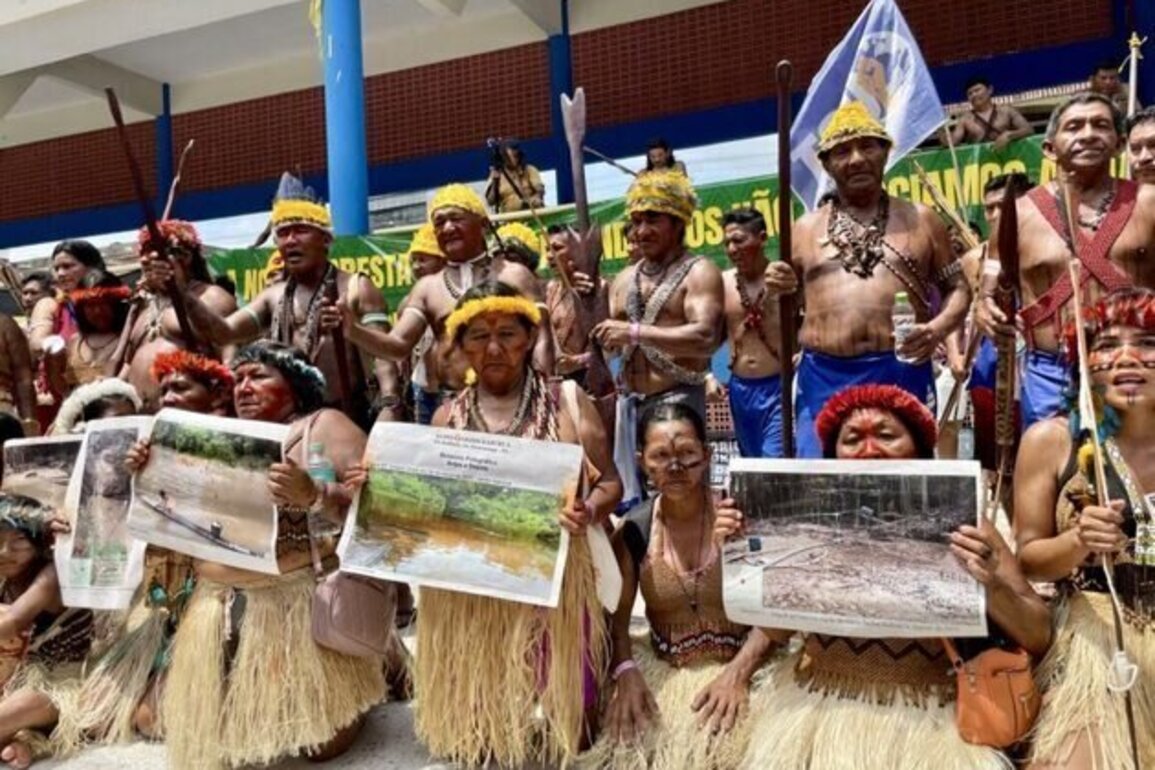
RIO DE JANEIRO (CN) - Brazil's Supreme Court upheld the traditional land rights. of the country's Indigenous people on Thursday, ruling for the second time to eliminate a doctrine intended to restrict their rights to land demarcation beyond the date the current Constitution was enacted.
The ruling comes a little more than two years after the court similarly rejected the temporal framework in a landmark decision. The so-called "marco temporal" doctrine states that tribes only had the rights to lands that were occupied or were under dispute when the Constitution was enacted in Oct. 5, 1988.
One month after the 2023 ruling, Congress passed Law 14,701, reviving the doctrine through legislation and altering rules governing the land demarcation process. President Luiz Inacio Lula da Silva vetoed parts of the bill, but lawmakers overrode the vetoes, allowing the law to take effect.
In his vote against the doctrine, Justice Gilmar Mendes, the rapporteur in the cases challenging the constitutionality of Law 14,701, said the debate requires a "public, republican and humane spirit" so Brazil can address rural land conflicts without resorting to a fixed cutoff date of Oct. 5, 1988.
"Our society cannot live with open wounds from centuries ago that still await solutions today," Mendes wrote.
According to the justice, requiring proof of occupation on that date places a disproportionate burden on Indigenous communities that were historically expelled from their territories through state or private actions, including forced removals, persecution and killings.
Brazil's Indigenous land rights
Brazil's 1988 Constitution recognizes, in Articles 231 and 232, Indigenous peoples' original rights to the lands they traditionally occupy and assigns the federal government the duty to demarcate, protect and enforce those rights.
Brazil currently has 823 demarcated Indigenous territories, covering just over 13% of the country's land area, according to Terras Indigenas do Brasil.
"The constitution's drafters deliberately used the word 'recognize' to state that Indigenous peoples' original rights to the lands they traditionally occupy are recognized," said Tatiana Emilia Dias Gomes, a professor of agrarian law at the Federal University of Bahia. "That verb means the right already existed even before the idea of the Brazilian state itself."
According to Gomes, the Constitution fully establishes Indigenous territorial rights, leaving the state with the role of formally acknowledging them through demarcation, without the need for additional regulation or legal reinterpretation.
She added that recognition of Indigenous land rights predates the 1988 Constitution itself. During the colonial period, the Portuguese Crown recognized Indigenous peoples as the "primary lords" of their lands - language used, for example, in a royal decree issued on April 1, 1680.
Although that recognition was systematically violated in practice, Gomes said the document shows that Indigenous occupation was long understood, at least formally, as ancestral and vested with its own territorial rights.
Data from the Indigenous Missionary Council shows that in the first year Law 14,701 was in force, there were 1,241 cases of violence against Indigenous land and property. The category includes state inaction and delays in land regularization, territorial conflicts, land invasions, illegal resource extraction and other damages. During the same period, the organization recorded 211 Indigenous people killed.
Both the Indigenous Missionary Council and the National Foundation for Indigenous Peoples, the federal agency responsible for administering land demarcation procedures, say the law hindered progress by creating legal obstacles and freezing administrative processes.
The situation adds to the recent legacy of former President Jair Bolsonaro, who pledged during his campaign not to demarcate any Indigenous lands and, during his term in office, recognized none.
Since the start of the current administration, 21 Indigenous territories have been formally recognized. At least 107 others have completed technical and administrative stages and are cleared to move forward in the demarcation process.
Judicial and congressional clash
In early 2024, Mendes created a special commission within the Supreme Court to discuss the application of Law 14,701 and possible adjustments to the legal framework governing Indigenous land demarcation.
The commission included representatives from the executive branch, Congress and state and municipal governments. Of its 24 members, only six represented Indigenous organizations. Citing the lack of parity and the idea that constitutional rights should not be subject to negotiation, the country's main Indigenous umbrella organization withdrew from the group.
Even after Indigenous groups left, the commission continued its work throughout 2024 and produced a proposal for legislative changes to the demarcation system, which was later incorporated into the rapporteur's vote, with a recommendation that it be sent to Congress.
For Juliana Cesario Alvim Gomes, a constitutional law professor at the State University of Rio de Janeiro, the case highlights a specific type of institutional conflict, distinct from other recent clashes between the Supreme Court and Congress.
Unlike disputes involving investigations of lawmakers or judicial intervention in political processes, she said, the marco temporal case directly concerns the protection of fundamental rights of a minority already recognized by the court in 2023.
In that context, she said, Congress' legislative response through Law 14,701 intensified the conflict by contradicting a judicial ruling on constitutional rights, while the court's handling of the case - including suspending demarcations and opening rounds of conciliation - prolonged uncertainty and hindered the enforcement of those rights.
She added that concessions introduced in the rapporteur's vote and the decision to keep the issue open created confusion over which interpretation ultimately prevails.
That confusion centers on two aspects of the vote that, despite rejecting the marco temporal doctrine, drew criticism from legal scholars, Indigenous organizations and two dissenting justices on the court.
The first involves expanding compensation for non-Indigenous occupants, including payment for the so-called "bare land," a mechanism not expressly provided for in the Constitution. Under that approach, individuals occupying land claimed by Indigenous peoples who assert good faith and valid title could be compensated so the land returns to Indigenous control.
The second point is the creation of a right of retention - allowing occupants to remain on the land until compensation is fully paid - and the possibility of compensating Indigenous communities when demarcation is deemed unfeasible.
Renata Corra Vieira, an Indigenous rights lawyer at the Instituto Socioambiental, said Mendes' vote introduced new barriers to completing demarcations.
"In Brazil's land history, many titles are fraudulent, the product of land grabbing and killings," she said. "And with the right of retention, Indigenous peoples will not return to their land unless the federal government has a massive budget for compensation, which it does not."
Vieira added that compensation also violates original rights by severing ancestral ties. "Indigenous peoples do not relate to land the way non-Indigenous people do," she said. "They have origin stories, and there is an entire cosmology tied to that specific territory that cannot be replaced."
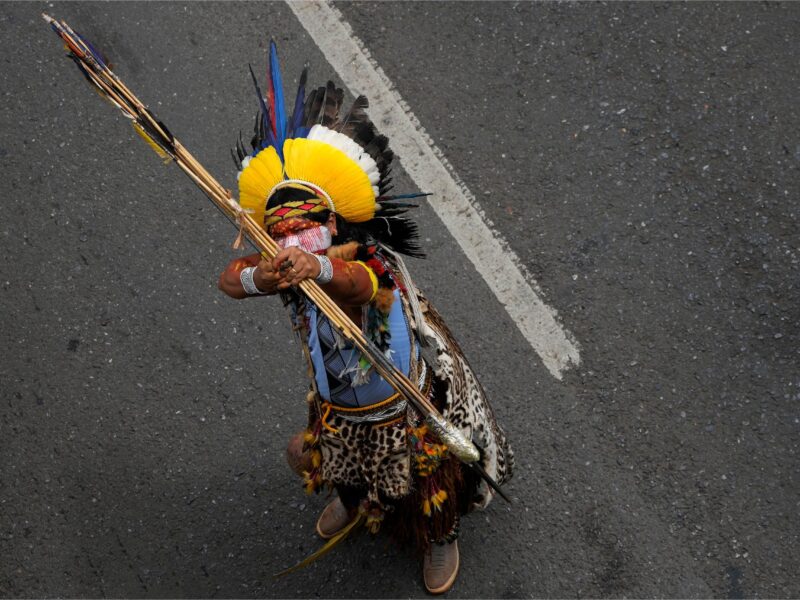
The dispute is far from over. Alongside the Supreme Court case, the Senate on Dec. 9 approved a proposed constitutional amendment that would write the marco temporal doctrine directly into the Constitution. The proposal must still be considered by the lower house.
Rodrigo Brandao Viveiros Pessanha, a constitutional law professor at the State University of Rio de Janeiro, said there is "a real and concrete possibility that this conflict will escalate."
"In a way, Congress is doubling down, and the issue will inevitably return to the Supreme Court," he said.
He said the most stable solution would require an agreement among the executive, legislative and judicial branches on criteria for Indigenous land demarcation.
"But that is a very difficult agreement, because the positions are antagonistic and the agribusiness sector - which favors the marco temporal doctrine - is far more represented than Indigenous peoples," he said. "This is an emblematic case of why the Supreme Court, in exercising constitutional review, must protect minorities that are underrepresented in Congress and depend on constitutional protection, particularly from the court."
Courthouse News reporter Marilia Marasciulo is based in Brazil.
Source: Courthouse News Service